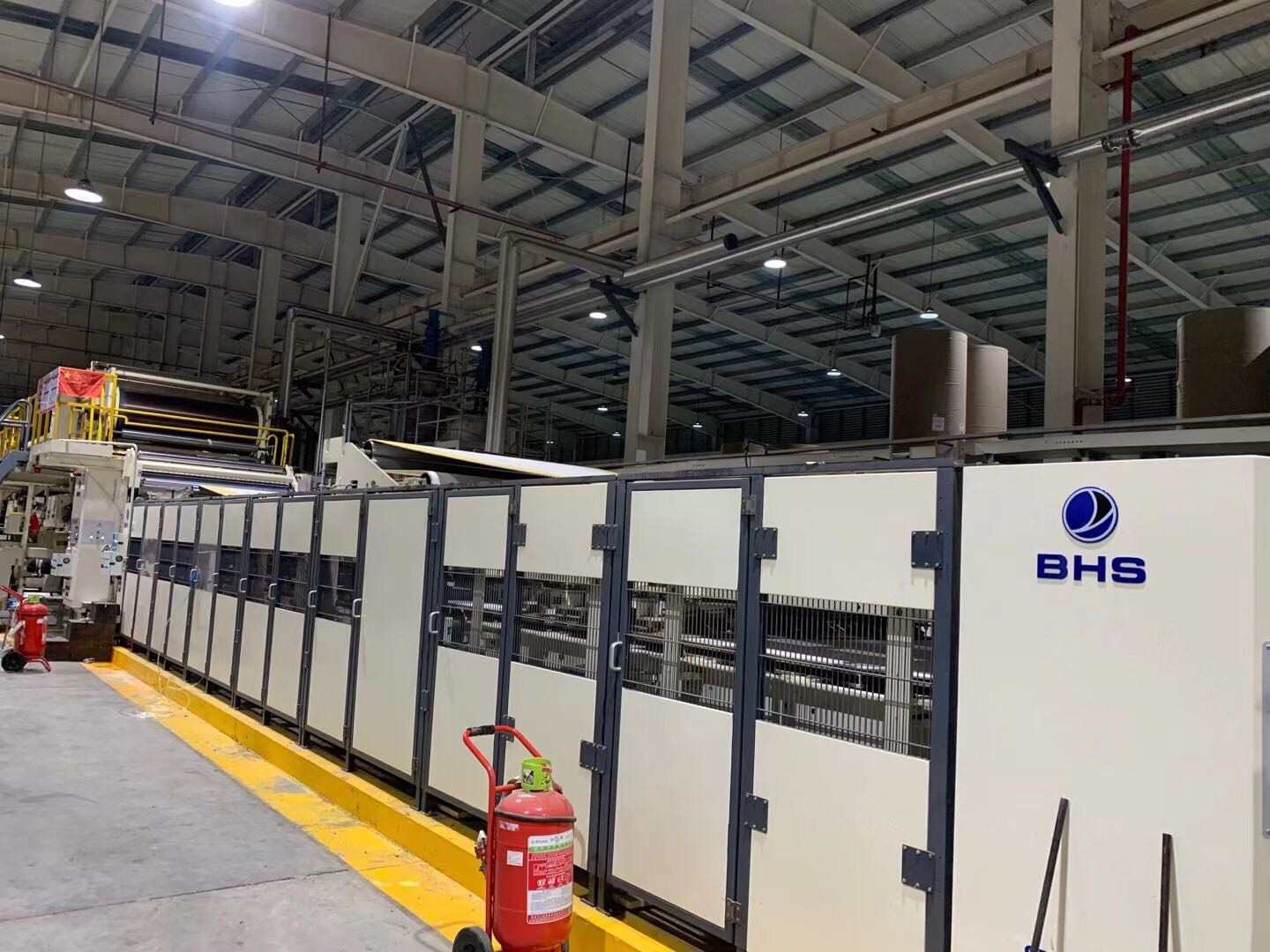
For a high-speed BHS or Fosber corrugator, a high-speed needle-punched belt with suitable dimensional stability, controlled air permeability, reliable seam construction, and optional aramid-reinforced edges is often a strong candidate.
However, a properly engineered woven corrugator belt may also meet the requirements.
The best belt is the one whose construction and operating specifications match the actual double facer, not simply the belt advertised for the highest speed.
Production speed, belt dimensions, heat exposure, moisture conditions, surface traction, tracking stability, and maintenance requirements should all influence the final selection.
A corrugator belt is a critical component in the double facer section of a corrugated board production line.
During production, the double facer combines single-face corrugated board with additional liner material while applying the heat and pressure required for adhesive bonding.
The corrugator belt helps transport the board through this process.
When the line operates at higher speeds, the belt must maintain consistent movement while exposed to mechanical tension, changing temperatures, and moisture.
If belt performance becomes unstable, several production problems may appear.
These include:
Belt slippage and inconsistent board transportation
Premature edge abrasion
Unstable tracking
Seam damage
Increased maintenance requirements
Potential disturbances to board quality and production continuity
However, belt problems should not be confused with every double facer process problem.
Poor bonding, board warp, or inconsistent drying can also result from paper properties, adhesive application, heating conditions, pressure settings, and other machine-related factors.
A reliable diagnosis considers the complete production process.
For procurement managers, this distinction is important because purchasing a more expensive belt will not necessarily solve a mechanical or process-control problem.
Three common options deserve consideration when evaluating replacement belts for demanding corrugator applications.
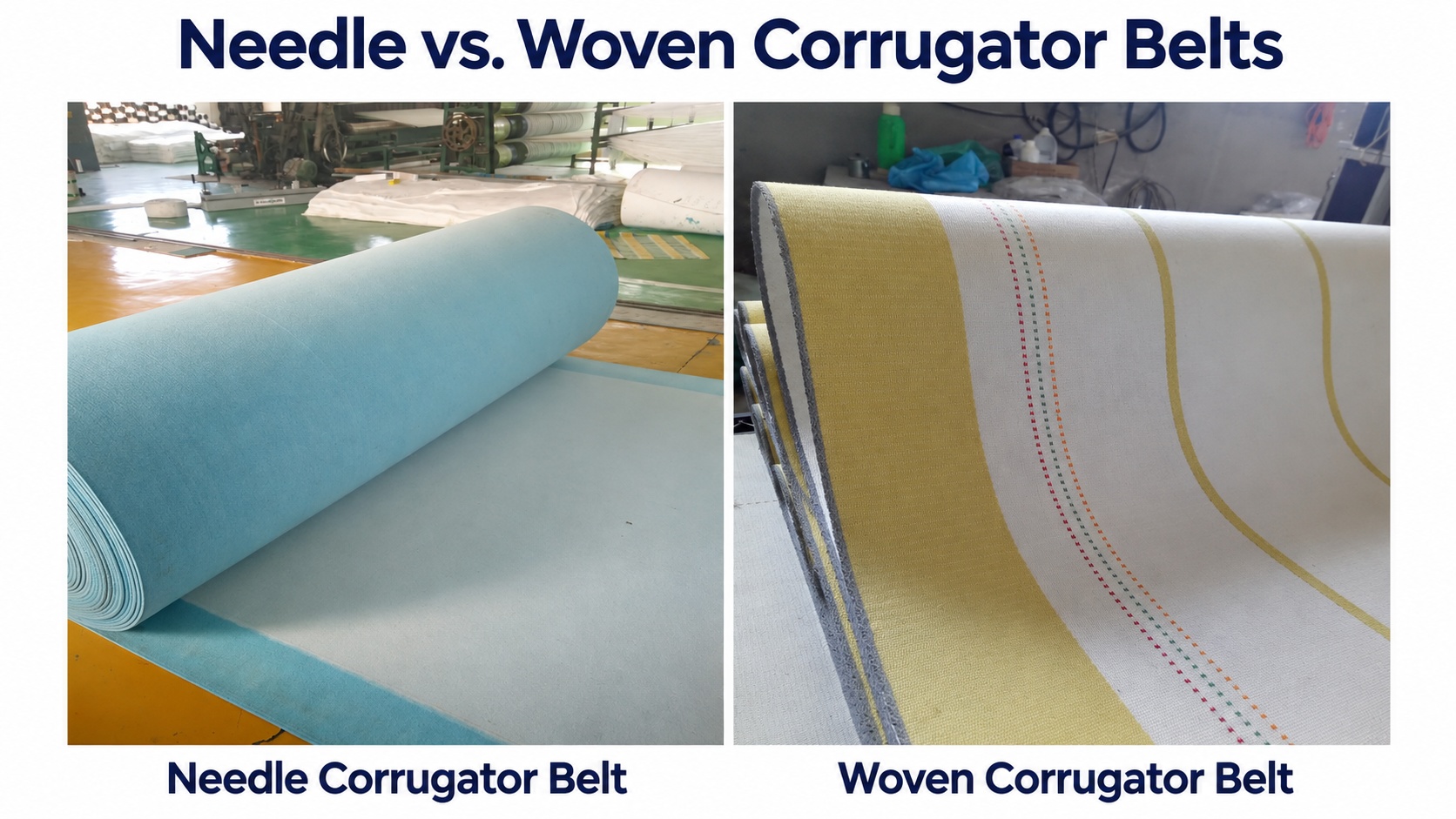
A needle-punched corrugator belt uses a mechanically consolidated fiber structure, generally supported by a construction designed to provide the required mechanical properties.
Its surface and internal structure can be engineered for particular double facer conditions.
Potential performance characteristics include suitable traction, controlled permeability, dimensional stability, and resistance to the expected thermal and moisture environment.
For high-speed production, these properties can be valuable.
For example, a belt with excessive elongation may require repeated tension adjustments or contribute to unstable operation.
A suitable high-speed needle belt should therefore be evaluated using measurable construction and operating characteristics.
Buyers should request technical information covering dimensional tolerances, thickness, permeability, seam construction, and intended operating conditions.
The description "high-speed needle belt" alone is insufficient.
Woven corrugator belts use interlaced yarn structures.
Their mechanical and surface properties depend on yarn materials, weave geometry, finishing processes, and other construction details.
A properly specified woven corrugator belt can provide stable board transportation and reliable operation in demanding applications.
Woven construction should not automatically be considered outdated or unsuitable for high-speed equipment.
Some production environments may favor a particular woven design because of its mechanical behavior, maintenance requirements, or compatibility with the existing double facer.
The selection should be based on documented operating requirements rather than assumptions about the construction category.
Aramid-reinforced edges are intended to improve resistance to certain forms of edge abrasion.
They may be useful when the belt repeatedly experiences localized mechanical contact or when edge damage is a documented cause of premature replacement.
For example, a corrugator producing a wide variety of board widths may experience changing edge-related operating conditions.
However, aramid reinforcement does not eliminate the need for correct tracking and alignment.
If a belt repeatedly contacts a guide or machine component because of incorrect alignment, reinforcement may delay visible damage without correcting the underlying cause.
Therefore, the decision to specify Kevlar-edge construction should follow an inspection of the existing belt and machine.
The following comparison summarizes the main selection considerations.
|
Factor |
Needle-punched belt |
Woven belt |
Aramid-edge construction |
|---|---|---|---|
|
Main feature |
Engineered fiber structure |
Interlaced yarn structure |
Reinforced belt edges |
|
Surface traction |
Construction-dependent |
Construction-dependent |
Depends on base belt |
|
Air permeability |
Specified by design |
Specified by design |
Depends on base belt |
|
Dimensional stability |
Depends on reinforcement |
Depends on yarn and weave |
Depends on base belt |
|
Edge abrasion resistance |
Depends on edge design |
Depends on edge design |
Additional localized protection |
|
High-speed suitability |
Available in suitable designs |
Available in suitable designs |
Requires suitable base belt |
|
Main purchasing consideration |
Verify complete specifications |
Verify complete specifications |
Confirm need for reinforcement |
One important point is often overlooked: Kevlar-edge construction is not a separate alternative to needle or woven construction.
Aramid reinforcement can be incorporated into an otherwise suitable belt design.
Therefore, a buyer may evaluate a high-speed needle belt with reinforced edges or another compatible belt construction with similar protection.
The correct combination depends on the application.
For additional technical background, see HUATAO's article on how Kevlar-edge corrugator belts improve production reliability.
The normal production speed and maximum operating speed should both be provided to the belt supplier.
A corrugator may have a high rated speed but operate at lower speeds for certain board grades or production orders.
Selecting a belt solely according to the machine's advertised maximum speed may overlook the conditions under which it spends most of its working life.
The supplier should confirm that the proposed belt is suitable for the intended speed range.
Correct dimensions are fundamental to replacement compatibility.
The buyer should verify:
Belt circumference
Belt width
Belt thickness
Seam arrangement
Any special installation requirements
Existing drawings or verified specifications are preferable when available.
A belt that is too long, too short, too wide, or unsuitable in thickness can create installation and operating problems.
During operation, the belt is exposed to continuous tension and changing environmental conditions.
Excessive elongation or dimensional distortion may contribute to tracking difficulties or repeated adjustments.
A suitable belt should maintain acceptable dimensional behavior under the specified operating conditions.
Air permeability is relevant to the belt's interaction with the heated and moisture-containing environment of the double facer.
However, more permeability is not automatically better.
The appropriate specification depends on machine design, board grades, process conditions, and the intended belt construction.
Buyers should avoid selecting a belt using permeability as an isolated performance indicator.
The belt must support reliable board transportation.
Insufficient traction can contribute to slip under certain conditions.
However, traction problems can also result from incorrect tension, contamination, worn drive components, or other machine conditions.
Before changing belt materials, inspect the transport system.
The seam is a critical area of the belt.
It must be compatible with the machine's operating geometry and installation requirements.
A poorly specified or incorrectly installed seam may contribute to vibration, marking, or premature mechanical damage.
The seam design should be reviewed as part of the quotation rather than treated as an insignificant accessory.
Edge reinforcement is worth considering when abrasion is a recurring problem.
However, a reinforced edge is not a universal requirement.
If the existing belt shows uniform wear without significant edge damage, other specifications may deserve greater purchasing priority.
BHS and Fosber both supply equipment for corrugated board production, but their double facer configurations and machine specifications are not necessarily interchangeable.
Even within the same manufacturer, equipment models and generations can have different installation requirements.
Therefore, a replacement belt should never be selected based solely on the statement "suitable for BHS" or "compatible with Fosber."
The supplier should verify the actual machine.
|
Compatibility parameter |
Why it matters |
|---|---|
|
Corrugator manufacturer |
Establishes equipment identification |
|
Double facer model |
Helps identify machine-specific requirements |
|
Machine generation |
May affect configuration |
|
Working width |
Supports dimensional compatibility |
|
Belt circumference |
Determines required replacement length |
|
Belt thickness |
Affects mechanical fit |
|
Seam construction |
Supports installation compatibility |
|
Operating speed |
Establishes performance requirements |
|
Existing belt design |
Provides a replacement reference |
A compatible aftermarket belt may be an appropriate option when these parameters have been checked.
However, general product descriptions are not proof of compatibility or OEM authorization.
A belt replacement should begin with an assessment of the existing failure pattern.
|
Symptom |
Possible causes |
Recommended action |
|---|---|---|
|
Belt slips during production |
Incorrect tension, contamination, drive issues, unsuitable traction |
Inspect tensioning and drive systems |
|
Belt moves sideways |
Roller misalignment, tracking problems, uneven tension |
Inspect alignment and tracking |
|
Belt edges wear rapidly |
Repeated contact, incorrect tracking, guide damage |
Identify contact points |
|
Seam fails prematurely |
Incorrect installation, unsuitable tension, mechanical interference |
Inspect seam and belt path |
|
Belt stretches excessively |
Operating stress, heat, construction mismatch |
Review operating conditions |
|
Board transportation becomes inconsistent |
Traction, pressure, tension, or process issues |
Inspect the complete double facer |
|
Belt surface becomes damaged |
Contamination, abnormal contact, thermal or mechanical stress |
Investigate damage source |
These symptoms can have more than one cause.
For example, replacing a slipping belt without inspecting the drive system may lead to the same problem with the new belt.
Likewise, installing a reinforced-edge belt on a misaligned machine may not eliminate premature edge wear.
The most economical solution is often to correct the underlying operating condition before installing the replacement.
The service life of a corrugator belt depends on its construction, operating conditions, installation quality, and maintenance practices.
There is no universally reliable replacement interval for every BHS or Fosber installation.
Maintenance teams should instead monitor belt condition and operating trends.
During normal production, operators can observe belt tracking, abnormal noise, visible edge condition, and unusual movement from safe inspection positions.
Any abnormal condition should be recorded for maintenance review.
During approved maintenance windows, inspect rollers, guides, tensioning components, and accessible belt surfaces.
Check for contamination, unusual abrasion, or signs of mechanical interference.
Inspect the seam according to the belt supplier's and machine manufacturer's procedures.
Look for deformation, separation, or abnormal wear.
Record the operating conditions associated with recurring problems.
Useful information includes production speed, board width, belt age, failure location, and maintenance actions.
These records can help determine whether a future replacement requires a different construction or whether the machine needs adjustment.
All physical inspections and adjustments should follow the plant's machinery isolation and lockout procedures.
Purchasing decisions often involve comparing OEM-specified belts with compatible aftermarket alternatives.
Price is important, but it should not be the only factor.
A lower purchase price may provide little value if the belt requires repeated adjustments, experiences premature damage, or causes unexpected downtime.
Conversely, a higher-priced belt does not automatically deliver better performance.
Buyers should compare:
Technical compatibility: Does the proposed belt match the machine's dimensional and operating requirements?
Construction details: Are materials, permeability, thickness, seam, and edge design clearly specified?
Inspection documentation: Can the supplier provide relevant dimensional or quality inspection information?
Installation requirements: Are the installation method and maintenance requirements understood?
Supplier communication: Can technical questions be answered before ordering?
Total operating cost: How do purchase cost, maintenance requirements, replacement labor, and potential downtime compare?
This approach supports more informed procurement decisions.
An incomplete inquiry can delay technical confirmation.
For a high-speed BHS or Fosber belt, the following information provides a useful starting point.
|
RFQ information |
Example of required detail |
|---|---|
|
Machine brand |
BHS or Fosber |
|
Exact model |
Model designation and double facer configuration |
|
Belt dimensions |
Circumference × width × thickness |
|
Operating speed |
Normal and maximum speed in m/min |
|
Existing belt type |
Needle, woven, or unknown |
|
Edge construction |
Standard or reinforced |
|
Seam type |
Existing joint design or photographs |
|
Current problem |
Slippage, tracking, edge wear, seam failure |
|
Supporting documents |
Drawings, specifications, or photographs |
If the existing belt type is unknown, photographs and machine information can help the supplier begin the review.
The objective is to establish the correct specification before production or shipment of the replacement belt.
A high-speed needle-punched belt may be a suitable candidate when its dimensional stability, permeability, traction, and seam design meet the machine's requirements. A properly specified woven belt may also be appropriate. The exact BHS double facer model and operating conditions must be verified before selecting a replacement.
The correct belt depends on the Fosber model, working width, belt dimensions, speed, and double facer configuration. Both needle-punched and woven constructions may be considered. Compatibility should be confirmed using machine specifications rather than a general brand-level claim.
Not universally. Needle-punched and woven belts have different structural characteristics, but their actual performance depends on materials, reinforcement, surface design, and operating conditions. A technical comparison should use verified specifications instead of assuming that one construction is always superior.
No. Aramid-reinforced edges are particularly relevant when edge abrasion is a documented problem. If the existing belt does not experience significant edge wear, reinforcement may not provide enough benefit to justify the additional cost. Machine alignment should always be checked.
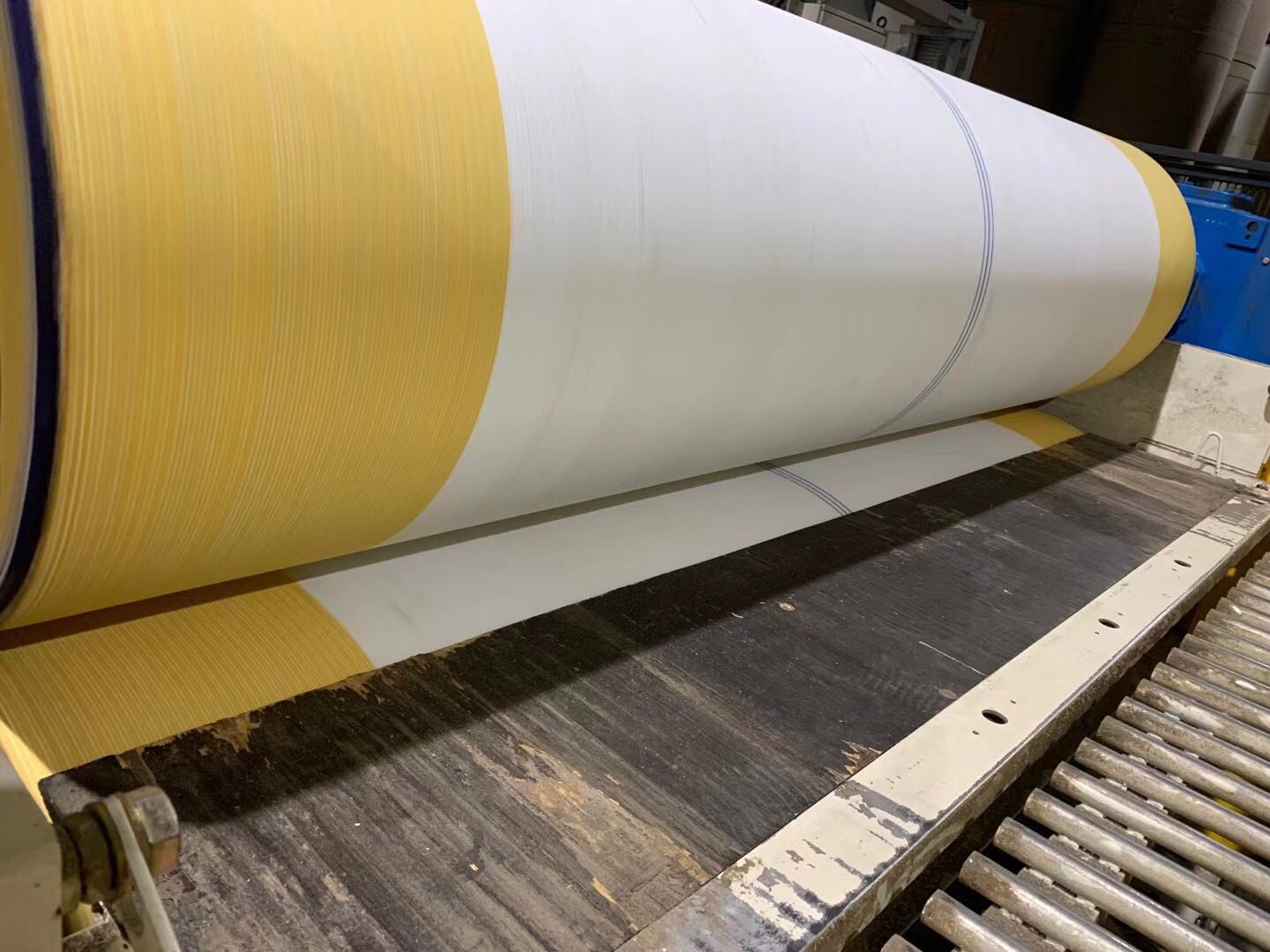
Possible causes include insufficient tension, unsuitable traction, contamination, worn drive components, or other mechanical problems. Increased speed may make an existing weakness more noticeable. Inspect the complete belt drive and tensioning arrangement before concluding that the belt construction is unsuitable.
Possibly, but the replacement must meet the machine's dimensional, mechanical, and operating requirements. Belt thickness, seam construction, permeability, traction, and tensioning compatibility should be reviewed before changing the construction.
There is no universal service-life figure. Belt life depends on operating speed, machine condition, tension, tracking, board grades, maintenance practices, and construction. Buyers should compare documented performance under similar conditions rather than relying on unsupported lifetime promises.
The essential dimensions generally include belt circumference, width, and thickness. The supplier may also require seam details, edge construction, machine model, and installation information. Existing technical drawings or verified replacement specifications can reduce the risk of dimensional errors.
For high-speed BHS and Fosber corrugators, needle-punched belts with suitable dimensional stability, controlled permeability, and reliable seam construction are often worth evaluating.
However, woven belts remain technically relevant, and Kevlar-edge reinforcement should be selected according to actual abrasion conditions.
The most effective purchasing decision considers the entire double facer operating environment.
Before ordering, confirm the machine model, belt dimensions, speed requirements, existing failure symptoms, and installation details.
This approach helps reduce compatibility risks and supports more reliable corrugated board production.
HUATAO GROUP supplies corrugator belts and related spare parts for corrugated board production lines.
Whether you need a high-speed needle belt, a woven corrugator belt, or an aramid-reinforced edge design, our team can review your operating requirements and discuss suitable replacement options.
For a technical review or quotation, send your BHS or Fosber machine model, belt dimensions, operating speed, and photographs of the existing belt.
Contact: Chris Xue | HUATAO GROUP
Email: chris@huataogroup.com
WhatsApp: +86 19322109200
Website: www.htwirebelt.com
can not be empty
can not be empty


Web: www.htwirebelt.com
TEL : +0086 0311 80690567
EMAIL:market@huataogroup.com
WhatsApp & WeChat :
+86 18033763037