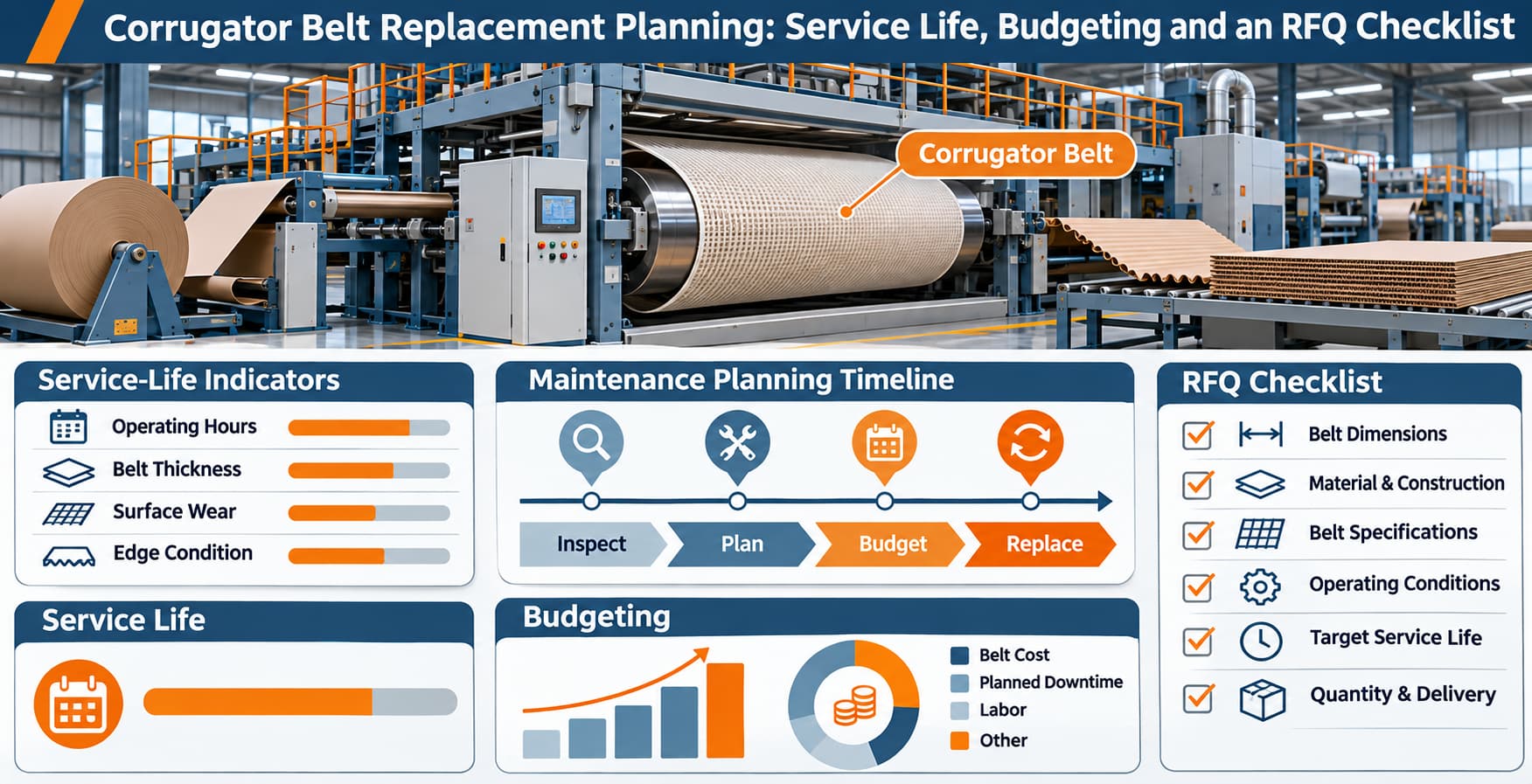
Procurement teams inherit an awkward consumable when they take over corrugator belt buying. It is not a commodity with a list price, and it is not a capital item with a depreciation schedule. It sits in between: a wear part whose replacement date moves with production planning, board mix and maintenance culture — and whose failure, if mistimed, costs far more than the belt itself.
This guide is written from the buying side. It covers what a realistic service life looks like, how to think about cost beyond the invoice, what to specify, and how to structure the RFQ so quotes arrive comparable.
Start with the honest range: most plants get 12 to 36 months from a corrugator belt on a double facer. Within that band:
- High-speed lines (300 m/min+), three shifts, heavy grades: 8 to 18 months is a normal planning figure, with edge degradation typically arriving before body wear.
- Mid-speed lines, two shifts, mixed board: 18 to 36 months.
- Slower lines, light grades, disciplined maintenance: beyond three years, often retired on condition rather than failure.
These are planning benchmarks, not guarantees, and any supplier who quotes a firm life number without asking about your line is guessing. Convert the calendar into operating units early: running hours, square meters of board, and heat-up cycles since installation. A year of three-shift running can consume a belt three times faster than a year of single shifts, and your budget cycle should reflect work done, not months elapsed.
A belt's invoice price is a fraction of its true cost equation. The rest is made up of items that never appear on the quote:
- Downtime for change. A belt that lasts four months longer defers a planned stop and, more importantly, eliminates the probability of an unplanned one.
- Energy. A belt that transfers heat poorly forces higher steam pressure and longer warm-ups. The cost lands on the utility bill every shift.
- Board quality drift. As a belt glazes and wears, bond quality fluctuates, warp increases, and downgrade rates creep up quietly.
- Collateral damage. A frayed edge or a lifting splice can score a hot plate or destroy a doctor blade — repairs that dwarf the price of the belt that caused them.
Total cost of ownership thinking does not always favor the premium option, but it almost never favors the cheapest one on a fast line. The comparison that matters is cost per 1,000 m² of acceptable board, and that number is invisible unless maintenance and procurement share their data.
Matching Construction to Duty
Two belt families dominate, and the duty decides which is right:
Woven belts — polyester and aramid yarns in an open structure. Strong heat transfer, light weight, good flexibility. Best where bond quality and consistent plate contact matter most. Their typical weakness is edge fraying and surface abrasion over time. A standard woven corrugator belt suits the majority of mid-speed applications.
Needle-punched belts — a denser felt-like structure. Higher abrasion resistance, better cushioning over uneven plates, stable tracking on wide machines. Heavier, and somewhat less efficient at transferring heat. Plants running abrasive recycled fiber often prefer a needle corrugator belt for longevity.
Between and beyond these sit reinforced-edge designs, including constructions that use high-temperature aramid fiber at the edge — the zone where most belts actually die. If your failure history is edge-driven on a fast line, that is the first specification conversation to have. The corrugator belts available today vary far more in edge construction, permeability and weight than historical buying habits usually reflect.
When belts come out early, the reason follows a short list, and each item on it has a different procurement implication:
- Edge fraying and hardening. The dominant mode on fast lines. Implication: the next specification should emphasize edge construction, not overall weight.
 - Permanent elongation. The take-up runs out of travel and tracking degrades. Implication: check whether the belt was correctly tensioned at installation, and whether the construction suits the machine's tension system.
- Surface glazing and starch build-up. A maintenance problem presenting as a product problem. Implication: before blaming the belt, audit glue application and cleaning — the replacement will age the same way under the same conditions.
- Heat aging of the fiber system. Gradual strength loss from years of thermal cycling, sometimes accelerated by hydrolysis in hot, humid conditions. Implication: favor constructions rated for the actual plate temperatures your line runs, not a generic figure.
- Mechanical damage. Jams, wrapped board, tools left in the wrong place. Implication: no belt specification fixes this; spares policy does.
Keeping a one-line reason with every retired belt costs nothing and, over two or three cycles, produces a failure profile that makes the next specification decision almost self-evident.
Four habits account for most regretted belt purchases:
1. Replacing like with like forever. The plant's product mix and speed today are not what they were when the original specification was written. Re-specify every second or third purchase.
2. Buying on invoice price alone. The costliest belt is the one that fails mid-order. Weight the decision toward documented construction and edge design.
3. Ordering from a stretched measurement. Measuring belt length under tension produces a short belt. Always measure with tension released and record the tension setting.
4. Ignoring storage. A spare belt cooked in a hot warehouse or deformed on a pallet can be compromised before its first shift. Storage conditions belong in the purchase discussion, because they belong to the buyer.
Every plant needs an answer to one question: what happens the night the belt fails with orders open? The options are:
1. Emergency order. Longest downtime, expedited freight, no leverage on price. The most expensive policy that looks the cheapest.
2. One spare on the shelf. The standard answer. Cost: capital tied up and correct storage required — dry, out of sunlight, on a mandrel, rotated so stock does not age in the corner.
3. Framework agreement with scheduled delivery. For multi-line plants, aligning belt delivery with planned maintenance windows removes both the capital question and the emergency scenario.
Whichever policy you choose, stock the small parts with the belt: guide rollers, doctor blades, tension hardware. These wear in sympathy with the belt, and a change window that stops because a roller was not ordered defeats the purpose. The corrugator machine spares range covers the parts that typically share the belt's replacement cycle.
Quotes are only comparable when the specification is complete. Before requesting offers, record:
- Machine — make and model of the corrugator, double facer working width.
- Belt dimensions — length measured with tension released, width, thickness of the current belt.
- Speed — design and actual operating speed in m/min.
- Product — flute profiles produced, board grades, typical trim widths, single-wall vs multi-wall share.
- Thermal profile — hot plate temperature range and number of plates.
- Splice — type of the current belt joint, and whether an endless construction is acceptable.
- History — how long the current belt ran, and why it is being replaced. Failure mode is specification data.
That last line matters more than it looks. A belt that died of edge fraying at 14 months on a three-shift line is telling the supplier to quote a reinforced-edge construction, not a like-for-like replacement. Suppliers can only use that information if you send it.
One workable pattern: review belt condition quarterly with maintenance, place the replacement order when take-up travel passes roughly two-thirds consumed or edge wear trends accelerate, and keep one spare for the critical line. Review the specification annually — board mixes drift, and a belt specified for last year's product may be quietly under-specified for this year's.
HUATAO GROUP works with board and box plants on belt specification, spare planning and replacement timing. Send your machine model, working width, speed and belt dimensions for a recommendation and quotation — including a view on whether your current specification matches the duty it is actually doing.
Contact: Chris Xue
Company: HUATAO Group
Email: chris@huataogroup.com
WhatsApp: +86 19322109200
Website: http://www.htwirebelt.com
can not be empty
can not be empty


Web: www.htwirebelt.com
TEL : +0086 0311 80690567
EMAIL:market@huataogroup.com
WhatsApp & WeChat :
+86 18033763037